
Nielsen Data: A Pivotal Turn as Streaming Surpasses the Combined Total of Broadcast and Cable for the First Time
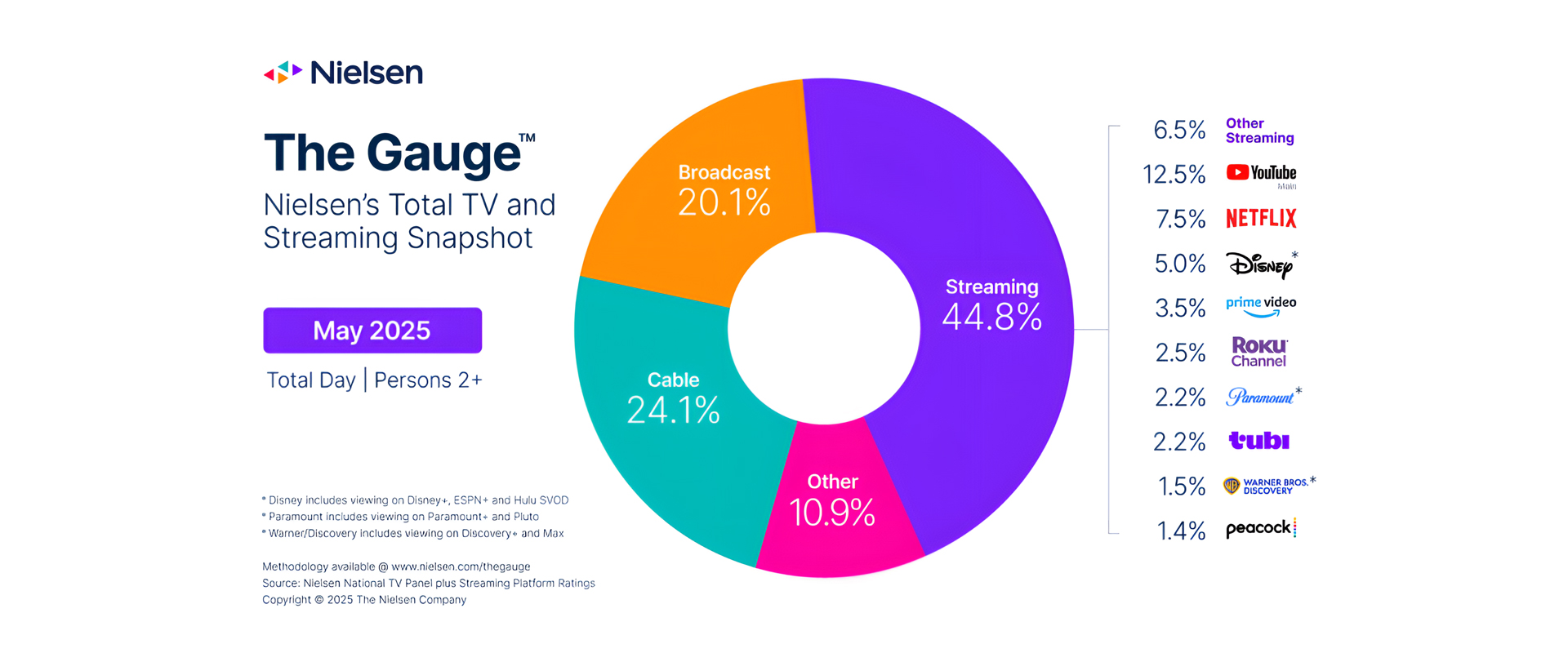
The headline marks a truly historic moment in the evolution of how Americans consume television. In May 2025, streaming accounted for 44.8% of total TV viewership, surpassing the combined 44.2% share of broadcast (20.1%) and cable (24.1%) for the first time ever, according to Nielsen’s monthly report, The Gauge™.
This milestone represents the largest share of TV viewing streaming has ever reached, underscoring its dominance in the modern media landscape.
Since Nielsen began tracking this data in 2021, streaming usage has surged 71%, demonstrating rapid adoption and shifting habits, while traditional television platforms have seen notable declines — broadcast viewing has decreased by 21%, and cable by 39% in the same period. The total TV viewing share that is neither broadcast, cable, nor streaming (such as gaming, physical media, and some on-demand content) remains stable around 10-11%.
The growth of streaming has been propelled by several key factors. Major contributors include the rise of free ad-supported streaming television (FAST) services such as Pluto TV, Roku Channel, and Tubi, which collectively accounted for 5.7% of total TV viewership in May 2025 — surpassing any individual broadcast network. Additionally, YouTube alone reached a record 12.5% share of TV usage in May, marking the highest viewing share for any streaming service in The Gauge’s history, outpacing even Netflix by about five percentage points.
Netflix remains a dominant subscription service, with hit programs like You reaching 4 billion minutes of viewing time in May. Meanwhile, traditional TV still holds importance, particularly for live sports and news, but its overall share continues to erode as more viewers favor the flexible, on-demand nature of streaming.
This milestone also coincides with the fourth anniversary of Nielsen’s The Gauge report, offering a clear lens into the transformation of television consumption over these years. Media companies have adapted their programming strategies to embrace streaming audiences, combining subscription and ad-supported models to capture varying consumer preferences.
Looking forward, while streaming’s lead is significant, Nielsen notes that shifts could still occur seasonally, especially with the return of broadcast premieres and football season — yet the trend strongly signals the new era of TV consumption is predominantly online.
Nielsen’s data not only captures a moment of transition but signals the ongoing reshaping of the audiovisual ecosystem. Streaming stands as the prevailing way audiences choose to watch TV, reflecting both technological advances and evolving cultural habits.
Share:
 COSM: The Future of Immersive Entertainment
 Italian Musician Roberto Tola Triumphs at the 2025 Hollywood Independent Music Awards
Related Posts



Nielsen Data: A Pivotal Turn as Streaming Surpasses the Combined Total of Broadcast and Cable for the First Time
The headline marks a truly historic moment in the evolution of how Americans consume television. In May 2025, streaming accounted for 44.8% of total TV viewership, surpassing the combined 44.2% share of broadcast (20.1%) and cable (24.1%) for the first time ever, according to Nielsen’s monthly report, The Gauge™.
This milestone represents the largest share of TV viewing streaming has ever reached, underscoring its dominance in the modern media landscape.
Since Nielsen began tracking this data in 2021, streaming usage has surged 71%, demonstrating rapid adoption and shifting habits, while traditional television platforms have seen notable declines — broadcast viewing has decreased by 21%, and cable by 39% in the same period. The total TV viewing share that is neither broadcast, cable, nor streaming (such as gaming, physical media, and some on-demand content) remains stable around 10-11%.
The growth of streaming has been propelled by several key factors. Major contributors include the rise of free ad-supported streaming television (FAST) services such as Pluto TV, Roku Channel, and Tubi, which collectively accounted for 5.7% of total TV viewership in May 2025 — surpassing any individual broadcast network. Additionally, YouTube alone reached a record 12.5% share of TV usage in May, marking the highest viewing share for any streaming service in The Gauge’s history, outpacing even Netflix by about five percentage points.
Netflix remains a dominant subscription service, with hit programs like You reaching 4 billion minutes of viewing time in May. Meanwhile, traditional TV still holds importance, particularly for live sports and news, but its overall share continues to erode as more viewers favor the flexible, on-demand nature of streaming.
This milestone also coincides with the fourth anniversary of Nielsen’s The Gauge report, offering a clear lens into the transformation of television consumption over these years. Media companies have adapted their programming strategies to embrace streaming audiences, combining subscription and ad-supported models to capture varying consumer preferences.
Looking forward, while streaming’s lead is significant, Nielsen notes that shifts could still occur seasonally, especially with the return of broadcast premieres and football season — yet the trend strongly signals the new era of TV consumption is predominantly online.
Nielsen’s data not only captures a moment of transition but signals the ongoing reshaping of the audiovisual ecosystem. Streaming stands as the prevailing way audiences choose to watch TV, reflecting both technological advances and evolving cultural habits.
Share:
COSM: The Future of Immersive EntertainmentItalian Musician Roberto Tola Triumphs at the 2025 Hollywood Independent Music Awards